
By Carmel Laurence
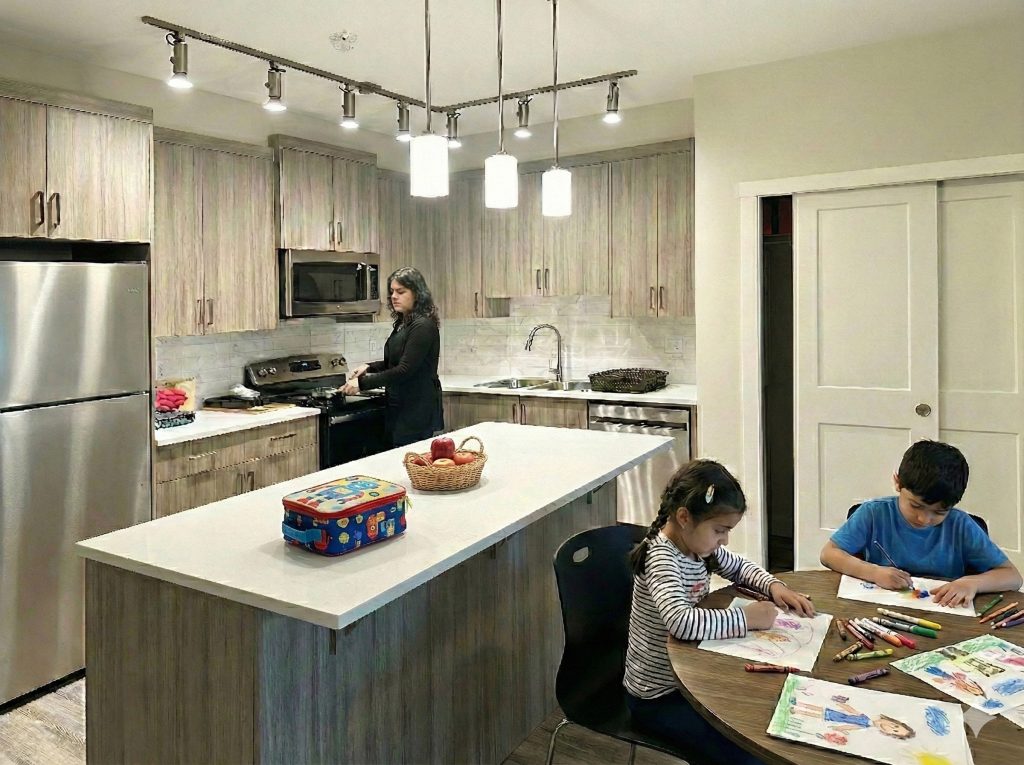
“The most rewarding piece for my staff is just being able to offer [women] something of real security [and] safety…after having gone through hell,” says Ishtar’s executive director.
“It’s been a lot of hard work, but it feels incredible to be at this point where we’re moving women in and they’re getting the experience of having a safe and secure home,” says Julia (Boyle) Davidson, Ishtar’s executive director.
The Women’s Transition Housing and Supports Program is a provincial initiative taken on by BC Housing in 2018 to safely shelter women and children impacted by domestic violence. Four program streams were defined in their 2019 report:
- Safe homes, which are short-term (approximately 10-day) shelters for women and children at risk of violence;
- Transition houses, which are typically dwellings with a number of private rooms and shared spaces available for 30-day stays, and are equipped with support services;
- Second-stage housing, which allows for survivors to move into safe and affordable independent living facilities with support available for up to 18 months;
- Long-term affordable rental housing.
New Roots House is funded by BC Housing. Housing and program fees are adjusted to 30 per cent of the resident’s income.
The Demand for Second-Stage Housing
Transition housing is designed to be a short-term solution for women after they leave violent homes, allowing them to be protected and supported through short-term safety planning and goal-setting.
But in the absence of a second-stage program, Davidson says that many of the women’s stays ended up being closer to three to six months. “It’s not realistic for someone who’s just been through a traumatic life experience to move into a transitional home and then find permanent housing 30 days later.”
She hopes to see New Roots House alleviate the strain on the transition houses, allowing more women to access immediate services while residents in need of longer-term support are moved into a facility that is better suited to their needs.
Ishtar also offers counselling programs for women, and psychoeducational programs for children and youth who have experienced or witnessed abuse in their households.
Privacy and Safety for Survivors
The safety of residents is of great concern to the team in charge of Ishtar’s programs. “If we’re not able to provide that and respond if situations come up, then that really puts the whole purpose of the program in jeopardy,” says Davidson.
Housing locations are kept confidential. There are safeguards and education in regards to online activity to prevent the women and children from being tracked over social media. Residents of New Roots House go through in-depth safety planning during the intake process, and there are strict protocols regarding guests, who must be registered. Security cameras are placed throughout the building. Aside from this, staff are onsite from 8 am to 8 pm, with emergency on-call support available overnight.
“The most rewarding piece for my staff is just being able to offer [the women] something of real security [and] safety…after having gone through hell,” says Davidson.
British Columbia’s Housing and Affordability Crisis
New Roots House is designed for low- and medium-income women and families, many of whom Davidson says are on income assistance. Some of the women who access transitional housing do not have legal status in Canada yet, though moving into second-stage and long-term housing requires them to obtain identification.
Financial issues due to unemployment or a low income can prevent women and their children from leaving unsafe situations. Davidson sees New Roots House as a “really necessary initiative” that allows women to have somewhere to go and rebuild their lives.
“Without that, I think the barrier of accessing market housing is too high,” she says.
In 2022, the Government of Canada reported that approximately 44 per cent of women over the age of 15 reported having experienced intimate partner violence. Combined with British Columbia’s housing crisis — with approximately 38 per cent of renters paying over 30 per cent of their total household income on rent and utilities — the need for safe and affordable accommodations for women and children fleeing from violence is clear.
New Roots House is currently at capacity due to residents moving from the two transition houses into second-stage housing shortly after its February launch. This means that Ishtar is meeting their goal of filling each of the 33 units with women, or women and their children.
“It’s a bit heartbreaking to already be in a position to be telling women that we don’t have housing available right after we launch, but at the same time, that was always the goal: to fill the facility and not have rooms sitting idle, because we want to serve as many women as we can,” says Davidson.
She anticipates that it will take time for the facility to experience a more staggered turnover process since all of the current residents have settled in recently; the waitlist will likely be reopened in 13-14 months. In that time, the transition houses are expected to have more regular turnover.
Long-term, the organization hopes to grow their second-stage program to be able to serve more women who are in need. As this new program develops, they plan to adapt as the housing needs of the Langley community shift. Davidson hopes that Ishtar may eventually be able to offer the full cycle of housing, including long-term affordable rentals, to the families they serve.
They are also working in partnership with the YWCA, which offers 48 long-term housing units.
“A Really Beautiful Moment”
One of the most rewarding moments at Ishtar has been showing women their new home. “It’s that moment where it becomes real for them…. where they’re seeing where their life is going,” says Davidson. Seeing the excitement on future residents’ faces when they see that they will have a brand-new, safe, stable home has greatly encouraged her team.
She expresses her gratitude to the Township of Langley and B.C. Housing for their support for the program.
“It’s a really beautiful moment to be opening this housing facility, providing real solutions to help women leave violent relationships and build safer, happier lives for themselves and for their children.”
We extend our sincere thanks to Carmel Laurence for writing and contributing this article.